

As diagnostic imaging technology continues to advance, so too does public concern over potential health risks associated with radiation exposure. In clinical practice, patient anxiety around X-rays and other diagnostic procedures has grown louder than the actual science behind the risk.
As a chiropractic physician working closely with radiologists and primary care providers, I frequently encounter patients who overestimate the dangers of diagnostic imaging while underestimating its value. While radiation safety is a legitimate clinical consideration, it must be understood in the proper context and guided by evidence-based medicine rather than fear.
1. Diagnostic Tests of Concern
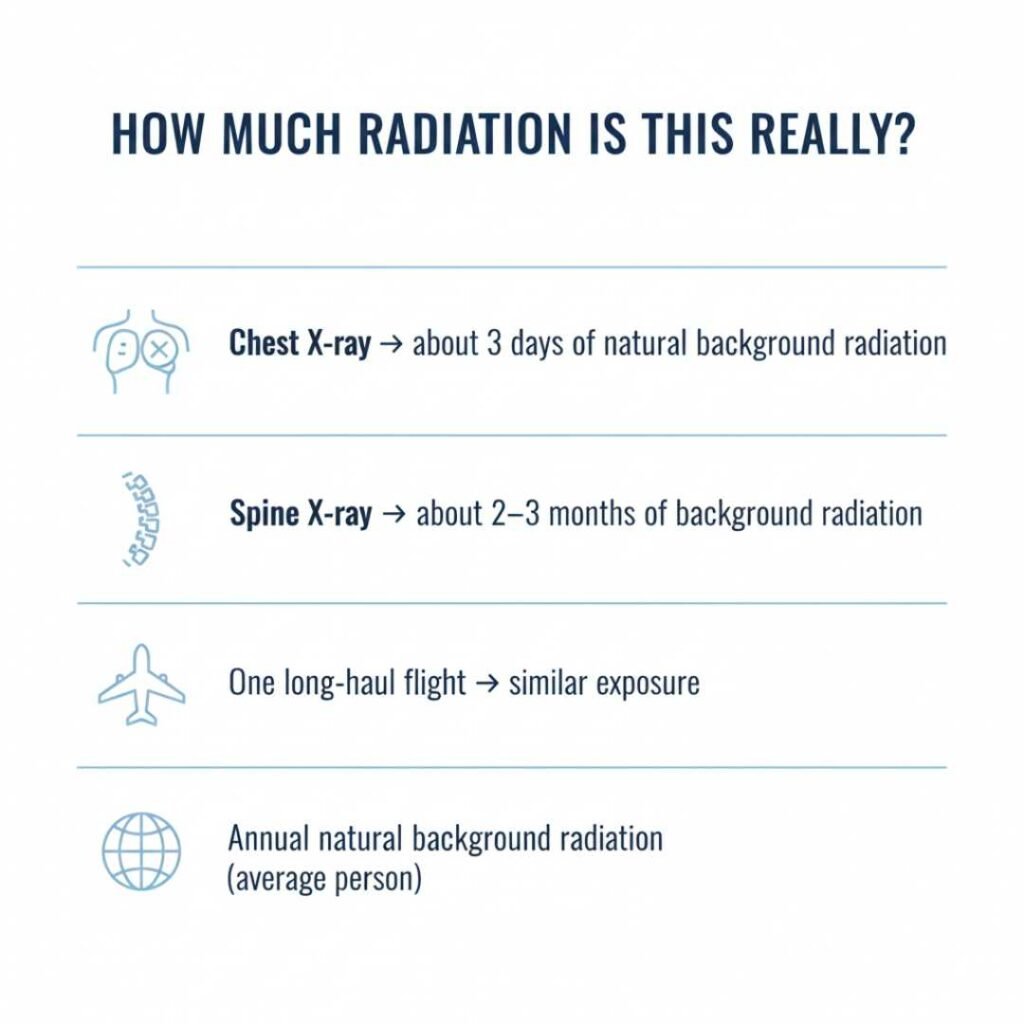
Patients often express worry about X-ray exposure, yet the actual dose delivered by these imaging tests is minimal. For example, a standard chest X-ray exposes a patient to roughly 10 millirem (mrem)—equivalent to just three days of natural background radiation. Even more extensive spinal imaging typically delivers 300–600 mrem, roughly equivalent to two to three months of background exposure.
To provide context, OSHA permits occupational workers up to 5,000 mrem per year, underscoring how diagnostic radiation levels fall far below any known harmful threshold. The misconception that X-rays pose a significant long-term cancer risk often stems from misunderstandings of radiation models applied to much higher exposure scenarios.
2. Vulnerable Populations
Certain groups, such as pediatric patients and pregnant women, require additional precautions. We follow guidelines from the American College of Radiology (ACR) to ensure safe and appropriate imaging practices.
However, it’s worth noting that the linear no-threshold (LNT) model, often used to estimate cancer risk from radiation, overestimates danger at diagnostic imaging levels. There’s limited evidence that the low doses from X-rays produce any long-term cancer risk, but the model remains a conservative framework for public safety.
3. Balancing Diagnostic Value and Risk
In modern clinical practice, the greatest risk isn’t from radiation, it’s from delayed or missed diagnoses due to excessive fear of imaging. The key lies in evidence-based decision-making guided by ACR Appropriateness Criteria.
When imaging is justified by clinical presentation, it provides invaluable information that can directly improve outcomes and prevent complications. Open collaboration between providers—chiropractors, radiologists, and primary care physicians—ensures that each scan adds meaningful diagnostic value.
4. Minimizing Unnecessary Exposure
At Complete Spine Solutions, we employ modern digital radiography systems designed to operate at the lowest effective dose, following the ALARA principle (As Low As Reasonably Achievable).
Our clinical criteria for imaging focus on patient safety, necessity, and transparency. When imaging is indicated, patients are educated about how diagnostic exposures compare to everyday sources of radiation, such as air travel, natural background, or occupational exposure. This context helps reduce anxiety and supports informed decision-making.

Book your consultation today!
Conclusion
Radiation exposure from modern diagnostic imaging—especially digital X-rays—remains well below established safety parameters. With proper protocols, collaborative oversight, and patient education, healthcare professionals can both minimize unnecessary exposure and maintain the diagnostic precision essential for quality care.
The ongoing conversation around imaging safety should focus not on fear, but on context, education, and balance, ensuring patients receive the right care, at the right time, for the right reason.